vllm-radiance: the capacity hunt and the model sweep
The investigation started here: one R9700, a long coding-agent history, and a host-RAM tier intended to keep more conversations useful. The vLLM fork produced the historical single-card milestones, the one-vs-two-card matrix and the 41-cell model/speculation sweep. These are distinct campaigns, with different models and cache precision—not one configuration progressing up a leaderboard.
The recorded ROCm 10.1 engine is 1.1.0-rc1.vllm0.30.0 (vLLM 0.30.0; PyTorch 2.12.0+rocm10.1 in the recorded matrix). The later standalone radiance engine is a separate stack. Compare their evidence.
Checkpoints, revisions and quant types
The campaigns moved across four target checkpoints and one drafter. Revisions are recorded verbatim from the exports.
| Checkpoint | Revision | Quant | Used in |
|---|---|---|---|
ukisai/Swift-1.5-Qwen3.8-27b-INT4 |
81a28ee75eb1cd469f209813a368a79a7e3db3bc |
AWQ+GPTQ INT4 hybrid (GDN) | 18 Oct single/dual matrix; single-card config |
ukisai/Swift-1.5-Qwen3.8-27b-W4A16-AWQ |
9dba8a05877150d587215a519ce6befec3c9978a |
AWQ INT4 W4A16 | 19 Oct spec campaign + sweep (Y/Z arms) |
amd/Qwen3.8-27B-Quark-AWQ-MXFP4 |
5233554c5fa56afda40150556b95573c2d7d29c0 |
Quark MXFP4 W4A8 | 19 Oct spec campaign + sweep (B/V/W/X arms) |
ethanwtodd/Swift-1.5-Qwen3.8-27b-Quark-RTN-MXFP4 |
459bc7fe8340e75dbd22701692db909e21917dc7 |
Quark MXFP4 RTN W4A8 | 19 Oct spec campaign + sweep (S/T/U arms, E1) |
tcclaviger/Qwen3.8-27B-DFlash2-FP8 |
— | FP8 drafter | DFlash2 K7 speculative lane only |
The INT4 checkpoint is the primary research target behind the single-card RAM16 milestone. The Swift-Quark RTN MXFP4 target belongs to the later sweep; its RTN weights must not be described as AWQ. Sources: model inventory, initial model campaign, agent-count sweep.
Configuration by campaign
These are deployment profiles, not an isolated A/B. The 131,070-token ceiling is a configured limit; it does not establish that every agent sustained the full context simultaneously.
| Campaign | TP | Context | Slots | Spec | KV | CPU tier | gpu-util |
|---|---|---|---|---|---|---|---|
| 18 Oct single (GPU A) | 1 | 131070 | 4 | MTP 4 | FP8 | 10 GiB ARC | 0.98 |
| 18 Oct dual | 2 | 168000 | 8 | MTP 8 | FP8 | 10 GiB ARC | 0.98 |
| 19 Oct spec + sweep | 2 | 131070 | 4 | non-spec / MTP K4 / DFlash2 K7 | BF16 | 10 GiB ARC | 0.98 |
All 19 Oct cells also fixed max-num-batched-tokens 16384,
long-prefill-token-threshold 2048 and prefix caching. Note the 19 Oct sweep used
BF16 KV — it did not test FP8 calibration, so it is a different evidence scope
from the 18 Oct FP8-KV matrix. The single-card INT4 profile is fully recorded in
data/rocm-10.1/single-card-gpu-a-configuration.json.
One card vs two: the recorded INT4 matrix
These rows all come from the 18 October FP8-KV deployment family. Single GPU A uses MTP-4 / four slots / 131,070 context; dual uses MTP-8 / eight slots / 168,000. Both use a 10 GiB ARC tier. It is a deployment comparison, not an isolated GPU-count scaling test.
| Agents | Single mean / maximum TTFT | Single mean request decode | Dual mean / maximum TTFT | Dual mean request decode |
|---|---|---|---|---|
| 1 | 7.46 / 18.78 s | 40.0 tok/s | 5.19 / 12.66 s | 45.4 tok/s |
| 2 | 11.92 / 40.64 s | 32.4 tok/s | 6.36 / 22.34 s | 26.9 tok/s |
| 3 | 71.46 / 456.19 s | 26.0 tok/s | 7.74 / 25.56 s | 18.3 tok/s |
| 4 | 101.38 / 654.91 s | 25.5 tok/s | 10.85 / 27.23 s | 16.4 tok/s |
Source: single/dual follow-up CSV, gpu-a and dual n1–4. At four agents the dual deployment has 89.3% lower mean TTFT, alongside a 35.7% lower request decode estimate. Different dimensions favour different profiles. Single-card preemptions are 0/0/7/12; dual records zero in all four cases in the acceptance report. Dual-phase swap usage rose from 0.37 to 1.07 GiB.
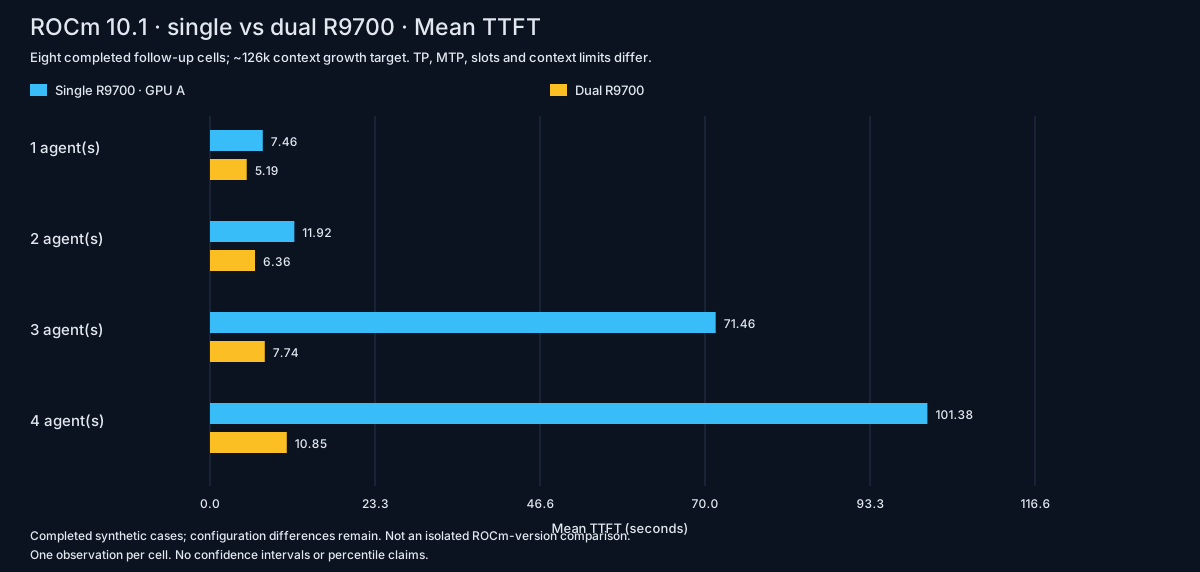
Useful range observed: one to two deep-context agents on the recorded single-card ROCm 10.1 profile; three to four develop long waits. The historical ROCm 7.14 RAM16 runs record 13.34/16.88 s mean TTFT at three/four agents, but use different settings and histories. A later 16 GiB tier caused severe host slowdown. Those results are retained context, not a recommendation to enlarge the current tier. Historical comparison.
What PP and TG can tell you
TTFT includes queueing and recovery. The matrix’s mean_request_decode_tokens_s is a reported short-response request estimate, not fleet productivity. In the later sweep, decode_tokens_s means total output ÷ whole-cell wall, while turn_tg_avg means the mean of valid request generation estimates. Those denominators must not be substituted for one another.
Raw kernel PP is unavailable as a validated matched comparison. pp_effective_ingest_tok_s includes cache reuse through prompt tokens ÷ TTFT. The sweep cache-hit proxy counts zero-TTFT turns and is not token-level cache efficiency. Missing/zero depth-band samples do not mean zero latency. Full dictionary and formulas.
The model sweep and the recommendation
The 19 Oct sweep is 41 cells, 1,160 turns, zero client errors, eight engine boots
(dual-r9700-agent-count-sweep-2026-10-19.csv).
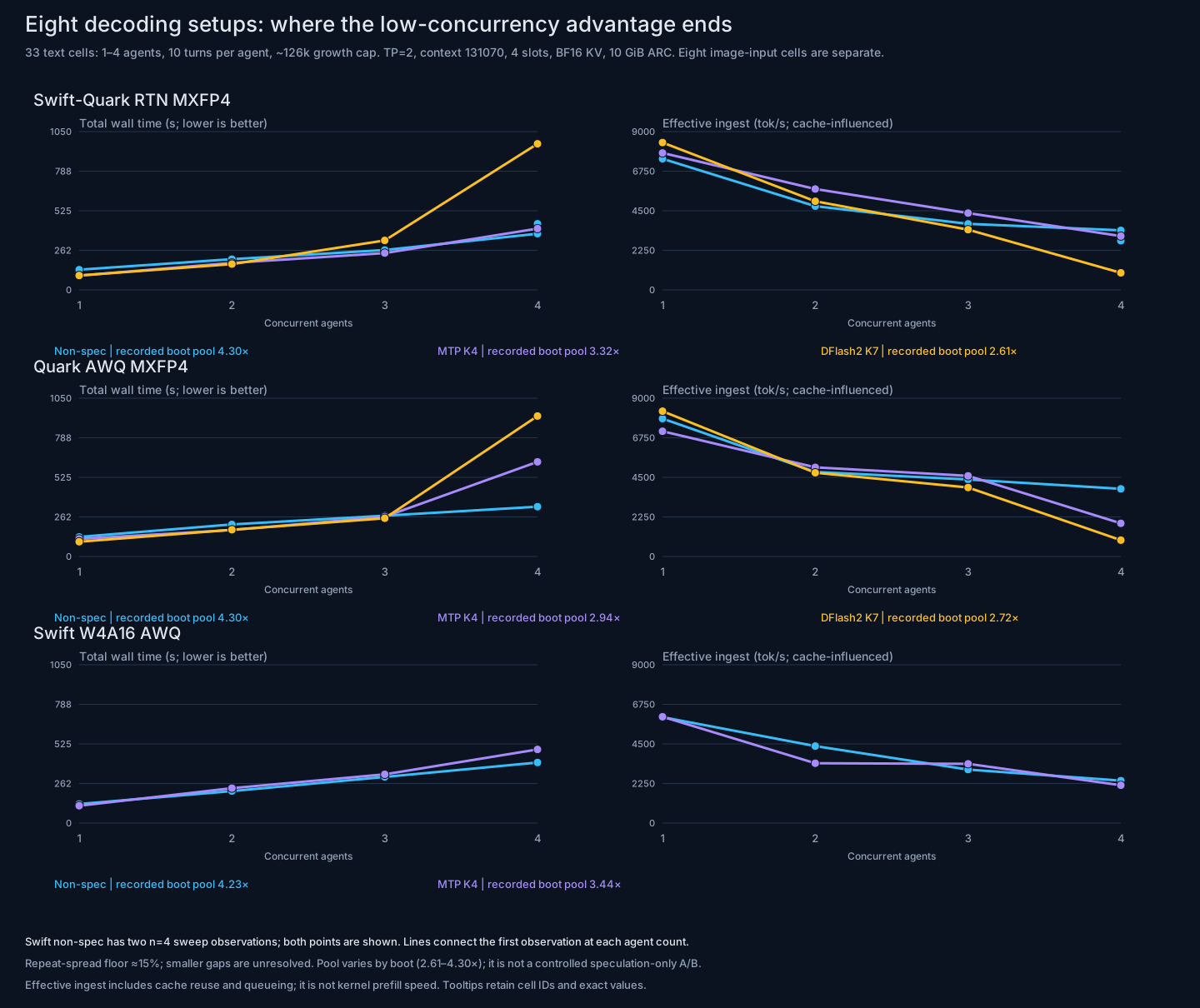
Whole-cell wall seconds at one to four agents (ten turns per agent):
| Target · lane | n=1 | n=2 | n=3 | n=4 | + images |
|---|---|---|---|---|---|
| Swift-Quark RTN · non-spec (S) | 134.2 | 203.7 | 264.7 | 372.8 / 439.0 | 537.1 |
| Swift-Quark RTN · MTP K4 (T) | 94.9 | 179.3 | 244.2 | 406.6 | 664.6 |
| Swift-Quark RTN · DFlash2 K7 (U) | 95.8 | 171.4 | 328.4 | 969.2 | 1674.9 |
| Quark AWQ · non-spec (V) | 130.1 | 213.0 | 270.9 | 330.4 | 463.4 |
The recorded campaign selected Swift-Quark RTN MXFP4, non-spec, for four-agent service (S4/S6; E1 reference). This selection included the author’s output-style preference; the fastest observed four-agent cell was AMD Quark AWQ non-spec V4, 330.4 s, compared with Swift-Quark’s 372.8/439.0 s repeats. There is no blinded quality test proving the preferred checkpoint better. The measured speculation pattern varies with concurrency: DFlash2 records ≈930–970 s at n4 on both tested MXFP4 targets, and MTP at n=4 is target-dependent (near-parity on Swift-Quark, a 1.9× longer wall on the Quark base, W4 628.0 s). The Quark base is the fastest n=4 cell (V4 330.4 s) — an observed setup difference with boot-pool variation, a separate result from the recorded checkpoint preference.
Limits that keep this contextual: mostly single observations, with Swift-Quark n4 repeat references at 372.8 / 439.0 / 439.6 s. The roughly 15% spread is descriptive variability, not a statistical threshold for other configurations; depth is capped at 126k; KV pool size also varies (2.61–4.30× in this sweep, recorded as full-context capacity equivalents) and is not isolated from speculation; BF16 KV throughout; vision/Falling-Blocks cells are seed-sensitive. This is a setup comparison, not a causal isolation of any single knob.
Real coding agents: Falling Blocks
Four concurrent agents (seeds 100–103) each built a Falling Blocks game.
falling-blocks-fleet-outcomes-2026-10-18.csv:
- Dual card — 4/4 clean exits, all artefacts, wall 30:10, original 32,768-token / 3,600 s budgets.
- Single-card first attempt — 3/4 delivered; agent 0 (seed 100) hit the 32,768-token cap in reasoning with zero tool calls and produced no files (a silent “success”).
- Single-card retry — 4/4 clean, wall 75:23, after raising per-request output to 65,536, correcting context to 131,070, compaction reserve to 67,584, and the per-agent cap to 5,400 s. Seed 100 then completed a full verified game.
All eleven produced games passed the reported vm.Script syntax check and the
mocked-DOM behaviour probe (movement, rotation, pause, hard-drop, reset, line clear)
— 11/11 with a confirmed line clear. These are not full browser qualification, and a
single fleet per profile does not establish that hardware changes model competence.
Detailed sweep report · Full matrix and fleet results · Historical overview.
Standing caveats
Single host (2× R9700 32 GiB, custom kernel, P2PDMA patch); GPU B has no single-card baseline. The 10 GiB tier is kept deliberately — a 16 GiB tier previously made the host crawl. No tested current single-card configuration establishes smooth 3–4-agent service at full 131k; the recorded dual deployment avoids the single-card long-wait pattern in this matrix. The selected results here are contextual to this hardware, these budgets and these workloads — do not generalise them silently.
Home · Compare · radiance · Charts · Stuff for nerds · Disclosure