Stuff for nerds
The charts are the last step. This is the plumbing: watch the GPUs, grow a conversation until memory matters, send four agents off to build something, collect what happened, and turn selected measurements into figures a reader can inspect.
The examples below explain the actual tools. Local generation, metrics reads, live inference, model conversion and service launch are different actions. Running the site generators does not touch inference. Running a benchmark or agent fleet does. The setup story explains the machine; reproducibility disclosure separates recoverable method from missing evidence.
The collection pipeline
| Stage | What did the work | What survives |
|---|---|---|
| Configure a deployment | Kernel/build work, model/calibration files, Podman and selected launchers | Patch, dated settings, selected image/revision identifiers; not a complete universal installer |
| Observe the host/engine | radiance-top and historical samplers |
Selected normalized resource traces; not every original recorder is bundled |
| Generate agent-shaped traffic | Recovered bench_agents4.py |
Exact synthetic generator, streaming metrics and summary format; model/runtime still required |
| Execute real coding tasks | Pi 1.1.0 client image, seeded prompt generator, agent/fleet shell runners | Recovered recipe/settings examples, scripts, selected game outputs and manifests |
| Summarize sessions | parse_falling_blocks_events.py |
Usage/timing CSV fields without conversation text; parser input remains private |
| Curate a release | Archive transformer, catalogues, reports and editorial review | Selected derived CSVs, reasons for exclusions and correction ledger |
| Make the publication | Python SVG generators, Markdown, Jekyll, layout/CSS, link checks | Source, generated charts, source hashes and site workflow |
There is no single raw-log pipeline behind every table. Some exports are transformed telemetry; others are curated campaign summaries or recorded boot values. The dictionary says which is which. A script being present does not prove it generated every historical result.
Watch a running engine
Metrics reads; no inference request or service change. Run on the GPU host for its local DRM sensor lanes. A remote metrics URL does not magically provide that host’s local sysfs sensors.
python3 scripts/radiance-top --url http://127.0.0.1:8000/metrics
python3 scripts/radiance-top --plain \
  --url http://127.0.0.1:8000/metrics --interval 2
If the endpoint requires authentication, the monitor accepts --api-key; see monitor options. Keep keys and captured operational output private.
Controls: w cycles 30/60/120/300/600-second and since-start windows; 1 switches aggregate/per-GPU presentation; p pauses the display; q or Escape quits. It recognizes both engines’ metric families. A missing counter stays unavailable rather than becoming a guessed number.
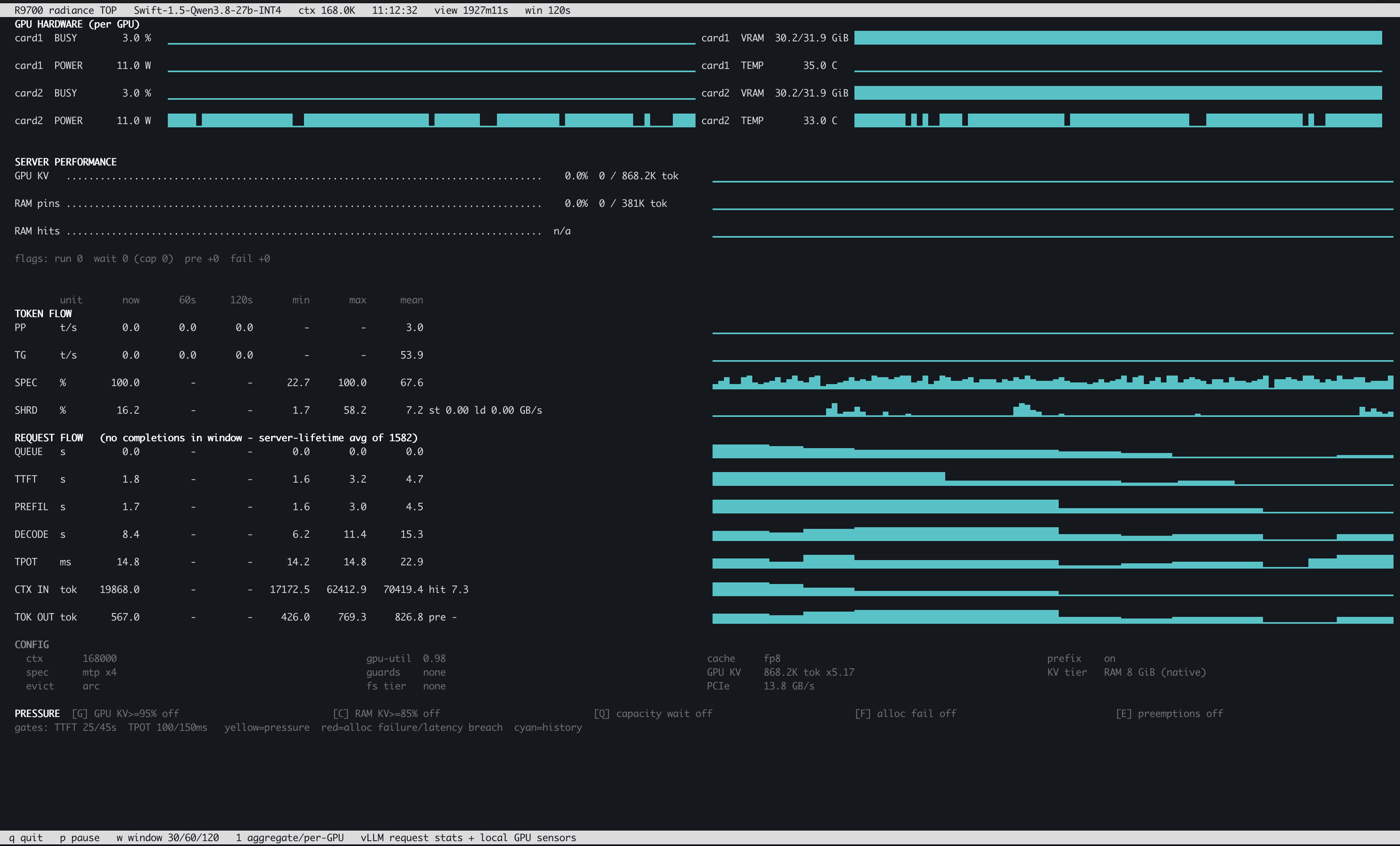
This is the retained monitor illustration, not a fresh measurement. Its PP/TG lanes follow engine-specific counters/gauges. Prompt intake with cached tokens, recompute credit, end-to-end output and per-turn generation are different rates. The monitor is a diagnostic instrument, not a substitute for a matched PP benchmark. Metric meanings.
Grow a synthetic conversation
Live inference. The portable replacement is useful for a new experiment:
python3 scripts/agent_bench.py \
  --base-url http://127.0.0.1:8000/v1 \
  --model YOUR_SERVED_MODEL_ID --agents 2 --turns 10 \
  --max-tool-chars 12000 --output src/reproductions/new-run.json
Create the private output directory first. This client generates records and writes a summary; it does not reproduce the original v4 workload, token distribution or turn totals. Confirm its model/context/output options against the server. A new run is new evidence, not a recreation of a published row by naming it after that row.
The original client is now inspectable too:
python3 scripts/recovered/bench_agents4.py --help
--help does not send requests. An actual example against an already configured server is:
mkdir -p src/reproductions/v4-example
python3 scripts/recovered/bench_agents4.py \
  --base-url http://127.0.0.1:8000 \
  --model YOUR_SERVED_MODEL_ID -n 1 \
  --chunk-tokens 10000 --max-tokens 126000 \
  --max-model-len 131070 -o 256 --turns-max 24 \
  --container YOUR_CONTAINER_NAME --label new-v4-example \
  --csv-append src/reproductions/v4-example/raw-summary.csv
Notice no /v1 on v4’s base URL: that client appends /v1/chat/completions itself. It generates synthetic tool-result text, optionally real procedural PNGs, and streams the reply. The growth target is checked on the previous prompt; it is not a hard request-depth ceiling. The named Podman container is inspected for runtime provenance. Its command/environment CSV column is private output and must be sanitized before any publication.
It supplies no sampling seed and can exit 0 with request errors recorded in its summary. Validating only $? is inadequate. The recovered grid adapter adds an error-count check, uses fresh output directories and keeps server configuration separate:
BASE_URL=http://127.0.0.1:8000 MODEL=YOUR_SERVED_MODEL_ID \
CONTAINER=YOUR_CONTAINER_NAME CONTEXT_LIMIT=131070 \
RESULTS_DIR=src/reproductions/new-single-grid \
bash scripts/recovered/run_grid.sh single-mtp4
That is a real four-cell workload. The name single-mtp4 does not select one GPU or enable drafting. The operator must already have matched those server settings. Original/adapter differences and quirks.
Four agents, four games, several definitions of success
Live inference and new client containers. The public task generator can be inspected without launching agents:
python3 scripts/falling_blocks_prompt.py --seed 100 \
  --output /tmp/falling-blocks-prompt.txt
For a real fleet, provide a Pi client image with the intended provider/model configured. The recovered Containerfile pins Pi 1.1.0; its provider and settings examples preserve the older budgets. Copy those examples as models.json and settings.json into a private build context, replace endpoint/credential placeholders, and build with Podman. The Node image tag and package dependencies are not a complete immutable lock.
On a Linux host with a loopback API, the recovered networking option is:
PI_IMAGE=YOUR_CONFIGURED_PI_IMAGE PI_PROVIDER=radiance \
PI_MODEL=YOUR_SERVED_MODEL_ID PI_NETWORK=host \
WORK_ROOT=src/reproductions/new-game-fleet \
bash scripts/run_falling_blocks_fleet.sh 4 100 3600 \
  http://127.0.0.1:8000/health
The final URL is a health check only. The client image’s provider configuration selects the inference endpoint. Seeds 100–103 select task variants; each agent gets a 3,600-second process limit. The runner writes prompts, sessions, logs and files. Those sessions are private until reviewed.
Summarize the latest session per agent without printing its message text:
python3 scripts/parse_falling_blocks_events.py \
  src/reproductions/new-game-fleet/agent-* \
  > src/reproductions/new-game-fleet/usage.csv
A usage CSV does not establish task success. Check files, exit status and the actual game separately. The recorded radiance fleet delivered all four games, with two clean exits and two delivered-then-timeout. The gallery preserves fifteen ROCm 10.1 game artefacts across four fleet attempts; the earlier eleven behaviour checks and later four syntax checks are different validation scopes. Fleet results.
Turn a public CSV into a chart
Local files only; no model required. The comparison generator uses the original public exports and the recorded profile metadata. It rounds wall/turn values explicitly; the renderer computes bars from those exports and writes source hashes.
python3 tools/build_comparison_data.py
python3 tools/build_home.py
python3 tools/build_navigation.py
python3 tools/check_recovery.py
Navigation also regenerates editorial figures and this page’s inventory. To render only the new figures: python3 tools/render_editorial.py. Older campaign chart families have their own renderers; archive transformation needs the separate private inputs. These commands do not rewrite narrative prose or remeasure inference.
The source-hash manifest makes the six editorial input CSVs identifiable. It does not prove the measurements true. Native site builds and link checks are the next layer, followed by visual inspection. A passing link check cannot certify a percentage, a game or a model.
Conversion, calibration and launchers
The recovered conversion adapter invokes rad-convert with the recorded M2 recipe and then rad-info. It requires the matching digest-pinned image, local model snapshot and a new output path; it writes a potentially large bundle. The source model, recipe implementation and exact engine environment remain required external inputs.
make_qkv_sidecar.py derives validated Q/K/V-only scales from an existing calibration artefact. It needs the matching Radiance Python packages and safetensors; it is not a standalone standard-library calibrator and does not reconstruct a missing calibration corpus. Calibration procedure.
The launch-*.sh scripts start inference containers and may alter host/shared-memory state. Their settings describe particular historical profiles or templates, not a current best default. Read them together with Podman operation, the setup story and the intended campaign. The kernel patch changes the host; a container cannot apply it by being launched.
The editorial agents’ own machinery
tools/editorial_fleet/ contains the recovered Python API driver and the actual initial/correction/proofreading prompts, plus the later documentation follow-up. They make live requests and write drafts/tool traces. They do not form part of the site build and do not directly edit the release. Run a pass from an isolated private workspace with a public-only repo/ copy; read the replay instructions.
The prompts preserve their historical errors, including a fleet outcome later corrected against exit receipts. They are useful evidence of the editing process, not a source to trust over the corrected data. No promise of identical AI output follows from publishing a seed. AI assistance and limits.
Every shipped script and tool
This inventory is generated from the checkout by tools/build_code_corner.py. Paths under tools/ refer to repository source and are deliberately excluded from the rendered site. Script links under scripts/ are static source files; visiting a link does not execute them. The radiance-top.png image and HTML game artefacts are assets rather than extra collection tools.
| Source | Effect / prerequisite | Purpose |
|---|---|---|
| scripts/agent_bench.py | Live inference | Portable replacement synthetic-load client; JSON summary |
| scripts/falling_blocks_prompt.py | Local files | Seeded game-task text generator |
| scripts/launch-example.sh | Inference launch / possible host changes | Historical profile or template; read selected settings before use |
| scripts/launch-ram16-tested.sh | Inference launch / possible host changes | Historical profile or template; read selected settings before use |
| scripts/launch-rocm10-tp2.sh | Inference launch / possible host changes | Historical profile or template; read selected settings before use |
| scripts/launch-tp1-rocm10.sh | Inference launch / possible host changes | Historical profile or template; read selected settings before use |
| scripts/launch-tp2-live.sh | Inference launch / possible host changes | Historical profile or template; read selected settings before use |
| scripts/make_qkv_sidecar.py | Local artefact creation | Validated Q/K/V scale derivation; Radiance/safetensors dependencies |
| scripts/parse_falling_blocks_events.py | Local private inputs | Latest Pi session per agent -> usage/timing fields |
| scripts/radiance-top | Metrics reads + local sensors | Dual-engine monitor; reads endpoints and host DRM, no inference |
| scripts/recovered/bench_agents4.py | Live inference + runtime inspection | Exact recovered original; synthetic text/images and raw CSV provenance |
| scripts/recovered/convert_model.sh | Model conversion container | Adapted M2 recipe; operator-provided image/input, new output |
| scripts/recovered/needle160k.py | Live inference immediately | Exact recovered large-prompt probe; no CLI/help mode |
| scripts/recovered/pi-fleet/Containerfile | Image build / network during build | Recovered Pi 1.1.0 recipe; requires operator provider/settings files |
| scripts/recovered/pi-fleet/models.example.json | Configuration example | Sanitized provider/endpoint/model budgets, not a credential file |
| scripts/recovered/pi-fleet/settings.example.json | Configuration example | Recorded Pi compaction and thinking settings |
| scripts/recovered/run_grid.sh | Live inference | Adapted sequential grid; server configuration is external |
| scripts/run_falling_blocks_agent.sh | Client containers + live inference | One seeded Pi task; writes private sessions/logs |
| scripts/run_falling_blocks_fleet.sh | Client containers + live inference | Concurrent game agents; separate health/provider endpoints |
tools/build_code_corner.py |
Local publication | Refresh this marked inventory; preserve narrative |
tools/build_comparison_data.py |
Local released inputs | Comparison arithmetic/rounding and corrected game paths |
tools/build_game_gallery.py |
Local publication | Verify released bytes/hashes and regenerate game gallery |
tools/build_home.py |
Local publication | Canonical README -> Pages index |
tools/build_navigation.py |
Local publication | Gallery/footer/front matter; calls editorial/code/game generators |
tools/build_release.py |
Local, private archive required | Curated telemetry/case transformation; RESEARCH_SOURCE required |
tools/build_run_index.py |
Local released inputs | Run index from transformed CSVs, catalogues and editorial notes |
tools/build_unchosen_graphs.py |
Local publication | Retained exploratory graph archive and exclusion descriptions |
tools/chart_theme.py |
Local SVG writes | Apply shared palette to existing SVGs |
tools/check_falling_blocks.cjs |
Local game-code execution | Node mocked-DOM checks for supported historical game API shapes |
tools/check_pages.py |
Local built HTML | Check local file/anchor links; does not render or validate facts |
tools/check_recovery.py |
Local source verification | Check recovery manifest hashes; no recovered code execution |
tools/editorial_fleet/documentation_followup.py |
Live inference + local tool reads | AI draft/evidence task orchestration; private outputs, not a publication build |
tools/editorial_fleet/documentation_proof.py |
Live inference + local tool reads | AI draft/evidence task orchestration; private outputs, not a publication build |
tools/editorial_fleet/fleet.py |
Live inference + local tool reads | AI draft/evidence task orchestration; private outputs, not a publication build |
tools/editorial_fleet/round2.py |
Live inference + local tool reads | AI draft/evidence task orchestration; private outputs, not a publication build |
tools/editorial_fleet/round3.py |
Live inference + local tool reads | AI draft/evidence task orchestration; private outputs, not a publication build |
tools/organise_results.py |
Local released inputs | Versioned result/catalogue organization and inventories |
tools/page_metadata.py |
Local publication | Add missing front matter; excludes private paths/AGENTS |
tools/render_csv.py |
Local released inputs | General CSV-to-SVG renderer |
tools/render_editorial.py |
Local released inputs | Editorial comparison charts and source-hash manifest |
tools/render_follow_up.py |
Local released inputs | Earlier single/dual/fleet report figures and hashes |
tools/render_spec_campaign.py |
Local released inputs | Model/speculation sweep, vision and depth-band figures |
| patches/0001-pci-p2pdma-whitelist-intel-4621.patch | Host kernel source change | Recorded Intel bridge P2PDMA eligibility patch; requires topology qualification |
.github/workflows/pages.yml |
CI build; deployment on configured main-branch events | Native Pages build, local-link checks and publication; does not run every generator |
Home · Compare · vllm-radiance · radiance · Charts · Disclosure