Dual R9700 model and spec-decode campaign (19 October 2026)
A follow-on campaign on the dual Radeon AI PRO R9700 pair (TP=2) that onboards one new checkpoint and measures every published speculative-decoding lane against plain batched decoding on long-context agent load. It runs alongside — and partly contradicts — the fast-lane numbers published by the engine project; see Contradiction with the published fast lanes.
Initial eight-cell campaign: scope and configuration
Fixed knobs across all eight cells: TP=2, max-model-len 131070,
max-num-seqs 4, max-num-batched-tokens 16384,
long-prefill-token-threshold 2048, prefix caching, bf16 KV (no FP8 KV),
10 GiB ARC CPU KV tier, gpu-utilization 0.98. Reference bench: four
concurrent coding agents, 10 turns each, 126k depth cap, greedy sampling.
Engine vllm-radiance:rocm10 (radiance 1.1.0-rc1.vllm0.30.0), ROCm 10.1.
One run per cell.
Targets: ukisai/Swift-1.5-Qwen3.8-27b-W4A16-AWQ (AWQ INT4 W4A16),
amd/Qwen3.8-27B-Quark-AWQ-MXFP4 (Quark MXFP4 W4A8), and the onboarded
ethanwtodd/Swift-1.5-Qwen3.8-27b-Quark-RTN-MXFP4. Speculative lanes:
MTP K4 (target-native head) and DFlash2 K7
(tcclaviger/Qwen3.8-27B-DFlash2-FP8, V2 model runner, PIECEWISE graphs,
TRITON_ATTN draft attention, 8192-token drafter window).
Results
Machine-readable export (all eight cells, 40/40 turns, zero client errors each).
| Cell | wall_s | decode tok/s | mean TTFT s | max TTFT s | KV pool |
|---|---|---|---|---|---|
| B2 Quark MXFP4 · non-spec | 420.8 | 17.04 | 16.80 | 56.95 | 4.38× |
| E1 Swift-Quark RTN · non-spec | 439.6 | 16.96 | 14.67 | 52.60 | 3.98× |
| A2 Swift W4A16 · non-spec | 484.3 | 12.67 | 23.19 | 72.76 | 4.32× |
| A1 Swift W4A16 · MTP K4 | 495.4 | 16.17 | 23.19 | 68.49 | 3.52× |
| B1 Quark MXFP4 · MTP K4 | 707.6 | 10.96 | 36.56 | 221.7 | 3.02× |
| E3 Swift-Quark RTN · DFlash2 K7 | 862.1 | 8.73 | 52.97 | 249.66 | 2.69× |
| B4 Quark MXFP4 · DFlash2 K7 | 911.7 | 7.75 | 57.52 | 427.14 | 2.69× |
| E2 Swift-Quark RTN · MTP K4 | 931.3 | 7.45 | 67.25 | 505.56 | 3.02× |
Findings
- Non-speculative decoding wins the initial four-agent campaign on every target. On this workload every speculative lane loses turn throughput to plain batched decoding on the same weights: E1 439.6 s vs E2 931.3 s (MTP) and E3 862.1 s (DFlash2).
- The KV pool is the dominant predictor. Wall time tracks pool concurrency almost monotonically; the draft pool’s reservation (MTP ≈126–179k tokens, DFlash2 ≈222k) pushes the pool below the 524k that four full-depth agents need, and preemption cascades dominate the deep bands (90–120 k TTFT: 152–172 s mean, up to 505 s).
- Speculative bursts are real and not usable at depth. DFlash2 rows show single-request decode of 119–171 tok/s with ~0–61 ms TP99 ITL when drafts are accepted — while co-resident agents starve. Per-request speed does not convert to fleet throughput at batch 4 (A1 vs A2: +27% per-request decode, wall unchanged).
- Acceptance depends on the target. Live counters during E3 measured ~39.4% draft acceptance (K7) for the base-trained drafter on the Swift finetune; E3 finished 49.6 s faster than B4 on the base target.
- New checkpoint onboarded: Swift in the Quark MXFP4 container.
ethanwtodd/Swift-1.5-Qwen3.8-27b-Quark-RTN-MXFP4(rev459bc7fe) replicates the winning AMD checkpoint’s Quark metadata exactly (identicalquantization_config, 127-entry exclude list, 1695-tensor inventory) and serves on the sameRadianceMxfp4W4A8kernels. Its weights are RTN, not AWQ, by author documented decision (the AWQ smoothing recipe produced pathological per-layer scales on this finetune; layernorms are restored from the BF16 base). Author GSM8K: 95.75% thinking-strict. Our smoke checks preserve the finetune’s generation style. E1 delivers campaign-best mean TTFT (14.67 s) with decode equal to the champion (16.96 vs 17.04 tok/s).
Contradiction with the published fast lanes
The engine project publishes fast-lane numbers on its own benchmark (non-spec 53.9, MTP K4 135.6, DFlash2 K5 172.3, DFlash2 K7 186.7 weighted tok/s), qualified at 8K context, concurrency 8, FP8 KV, on FP8/MXFP4 targets. Our cells run 126k depth, 4 agents, bf16 KV — outside that envelope. On our envelope the ordering inverts: the published fastest lane (DFlash2 K7) is among the slowest here, and non-spec — the published baseline — is fastest. This does not establish that the published numbers are wrong in their envelope; it establishes that they do not transfer to long-context agent load on this hardware, and that the engine’s own qualification note (“non-spec recommended; DFlash2 qualified at 8K/C8”) is load-bearing for exactly this reason.
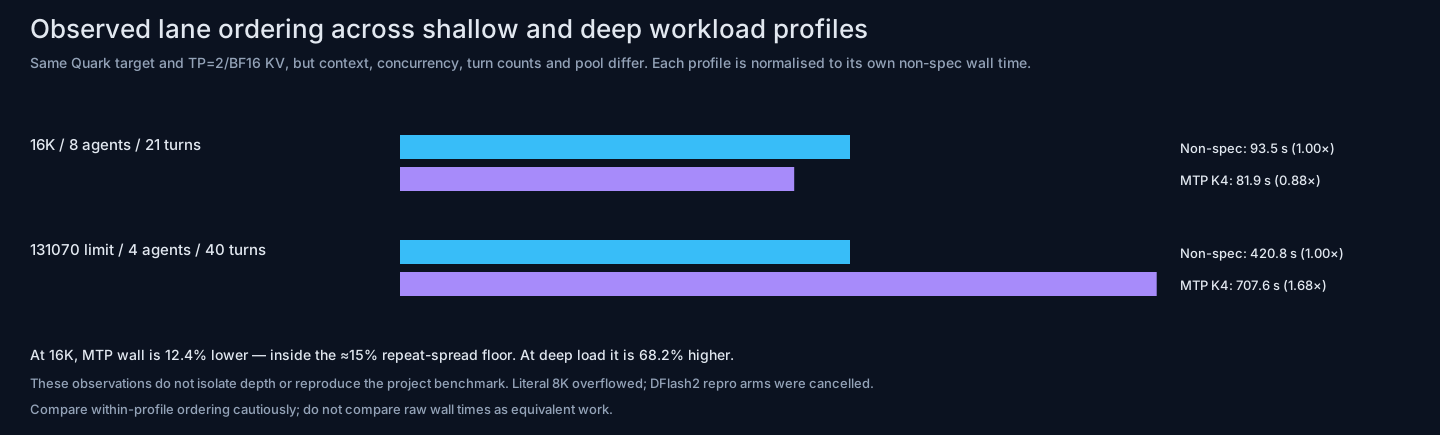
This campaign did not reproduce the published numbers exactly: the project’s benchmark harness is not shipped in the image (verified by filesystem search). A shallow-zone reproduction with our own agent bench measured the same Quark lanes at 16K context, 8 agents — the literal 8K/C8 envelope is infeasible with this harness (its fixed system+task prompt is ~7.9k real tokens, so turn 1 alone overflows an 8192-token context; recorded as a gate-fail, not a cell). In the shallow zone MTP had lower observed wall time (81.9 s vs 93.5 s, a 12.4% reduction), but this lies inside the ≈15% repeat-spread floor. The deep campaign pair favoured non-spec (420.8 s vs 707.6 s). Context, concurrency, turn count and pool changed together: this is an observed ordering difference, not an isolated depth effect or a robust reproduction claim. Shallow cells R1/R2 and deep cells B1/B2. Chart: lane transfer 16K vs 126k · Shallow-zone cells (DFlash2 arms at 16K were cancelled by scope decision; two cells per side of the inversion are measured).
Agent-count scaling, prompt processing, and vision input
All eight engine setups — three targets (Swift-Quark RTN MXFP4, Quark AWQ
MXFP4, Swift W4A16 AWQ) × lanes (non-spec, MTP K4, and DFlash2 K7 on the
two MXFP4 targets) — were swept at 126k depth: 1, 2, 3, and 4 concurrent
agents (10 turns each), plus a synthetic vision-input run that injects one
procedural 512×512 PNG per turn per agent (failing-game-UI screenshots as
multimodal input), plus a repeat of the 4-agent point on the serving
checkpoint. 41 cells, 1,160 turns, zero errors, eight engine boots,
zero crashes. Prompt ingest rate is prompt tokens ÷ TTFT over
non-cached turns — an effective client-side rate that includes
prefix-cache reuse (the cached prefix is not recomputed, so this exceeds
the GPU’s kernel prefill rate by design); prefix_cache_hit_frac is the fraction of turns with TTFT recorded as 0.00 s, used as a cache-hit proxy; it does not independently measure token-level cache reuse. The earlier handover estimated kernel prefill near 750–850 tok/s. These client-side fields do not measure that rate directly, so no kernel-throughput claim is derived from this export.
Machine-readable export · Chart: scaling and PP
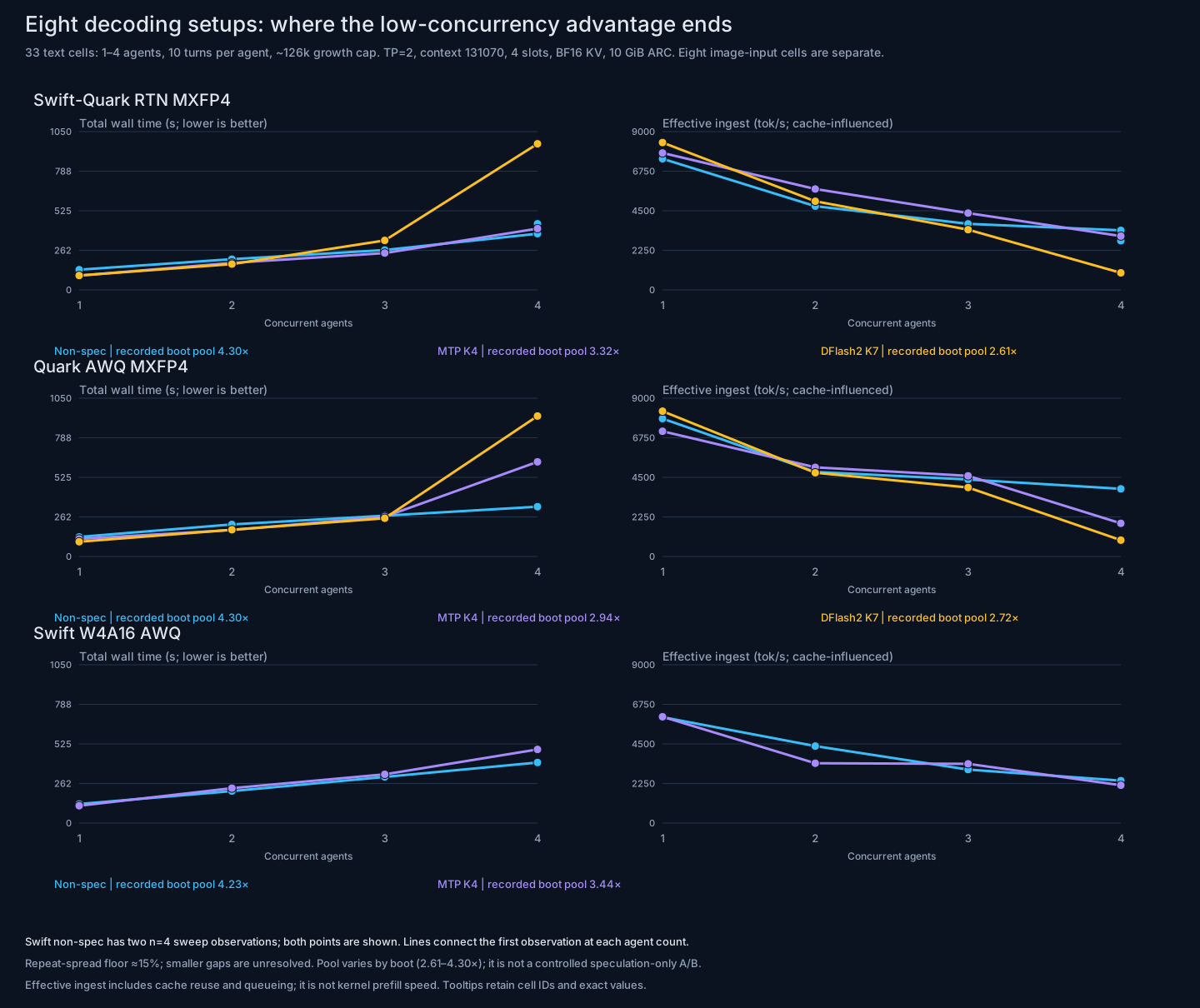
Wall seconds per cell (lower is better; every cell carries decode, TTFT, depth-band, ingest, and KV-pool columns in the CSV):
| Target · lane | n=1 | n=2 | n=3 | n=4 | Falling Blocks |
|---|---|---|---|---|---|
| Swift-Quark MXFP4 · non-spec | 134.2 | 203.7 | 264.7 | 372.8 / 439.0 | 537.1 |
| Swift-Quark MXFP4 · MTP K4 | 94.9 | 179.3 | 244.2 | 406.6 | 664.6 |
| Swift-Quark MXFP4 · DFlash2 K7 | 95.8 | 171.4 | 328.4 | 969.2 | 1674.9 |
| Quark AWQ MXFP4 · non-spec | 130.1 | 213.0 | 270.9 | 330.4 | 463.4 |
| Quark AWQ MXFP4 · MTP K4 | 116.4 | 175.6 | 264.4 | 628.0 | 1385.2 |
| Quark AWQ MXFP4 · DFlash2 K7 | 97.6 | 177.6 | 253.9 | 931.7 | 1609.0 |
| Swift W4A16 · non-spec | 126.7 | 212.1 | 306.4 | 401.8 | 651.9 |
| Swift W4A16 · MTP K4 | 115.1 | 231.6 | 323.1 | 488.7 | 802.9 |
- Speculation is a low-concurrency option, with target-specific gains. Swift-Quark MTP/DFlash2 at n=1 measured 94.9/95.8 s against 134.2 s non-spec (T1/U1 vs S1). At n=2 the reductions were 12.0%/15.9% (T2/U2 vs S2); the MTP difference is below the repeat-spread floor. On W4A16, MTP at n=2 was slower, 231.6 vs 212.1 s (Z2 vs Y2). Do not claim a universal 25–30% gain across targets and agent counts.
- Full-load operation favours non-spec as the default. Quark’s n=4 non-spec cell was 330.4 s, against 628.0 s MTP and 931.7 s DFlash2 (V4/W4/X4). On Swift-Quark, MTP at 406.6 s lies within the non-spec repeat spread (372.8/439.0 s); its rank is unresolved. DFlash2 at 969.2 s is clearly slower (U4). These are setup comparisons, not a causal isolation of speculation.
- MTP’s n=4 behaviour is target-dependent. Swift-Quark rides MTP to near-parity at n=4 (406.6 vs 372.8 s); on the Quark base the same K4 collapses to 628.0 s (1.9× its non-spec), and on W4A16 MTP loses too (488.7 vs 401.8). Same MTP depth, different targets and boot pools (3.32× / 2.94× / 3.44×); this export does not isolate acceptance from capacity.
- The DFlash2 K7 cliff is target-independent. At n=4 both targets land ~930–970 s with ingest collapsing to ~930–970 tok/s (deep bands ~630); at n=3 the base target handles it (253.9 s, even beating its non-spec 270.9, a gap below the repeat-spread floor) while Swift-Quark is slower (328.4 vs 264.7). The recommendation is to reserve DFlash2 for low-concurrency use on this profile.
- Vision penalises speculation hardest. On Quark, FB wall goes 463.4 → 1385.2 → 1609.0 s (non-spec → MTP → DFlash, 3.0–3.5×); on Swift-Quark 537.1 → 664.6 → 1674.9. Image prefill + draft tax + pool pressure compound.
- W4A16 pays a decode tax: 10.3–19.8 tok/s vs 16–23 for the MXFP4 lanes — these are different quantisation/kernel paths, not a generic claim that one INT4 bit width is smaller than another. It stays competitive at n=1 (115.1 s with MTP is the fastest single-agent cell of its target) and trails at n≥3.
- Per-agent decode is nearly flat with concurrency (16.6 → 24.9 tok/s on the non-spec lanes): the box is weight-bandwidth-bound at these batch sizes, so wall time grows sublinearly (1.97× for 3× agents) and fleet throughput rises with concurrency.
- Effective prompt ingest collapses with queueing: 6,019–8,381 tok/s single-stream → 1,885–3,848 at four agents on healthy lanes (client-side rate; the kernel rate is the ~750–850 tok/s above — the gap is prefix caching doing its job). Ingest rises within each run’s depth bands (bigger prefills amortise scheduling).
- Repeat spread on the 4-agent point: 372.8 / 439.0 / 439.6 s (E1) — a 15% spread; single-run gaps below ~15% on this box are not separable.
- The vision lane is seed-sensitive. The W4A16 FB run (651.9 s) drew a short-turn, shallow-depth agent profile (mean TTFT 2.77 s, 95% cache hits, deep bands empty, tg 9.1) where the Quark FB runs drew deep ones. Compare each vision cell with its n=4 text twin in the same lane; even that difference includes changed histories and cache reuse, not only image computation.
Vision increments and depth-band coverage
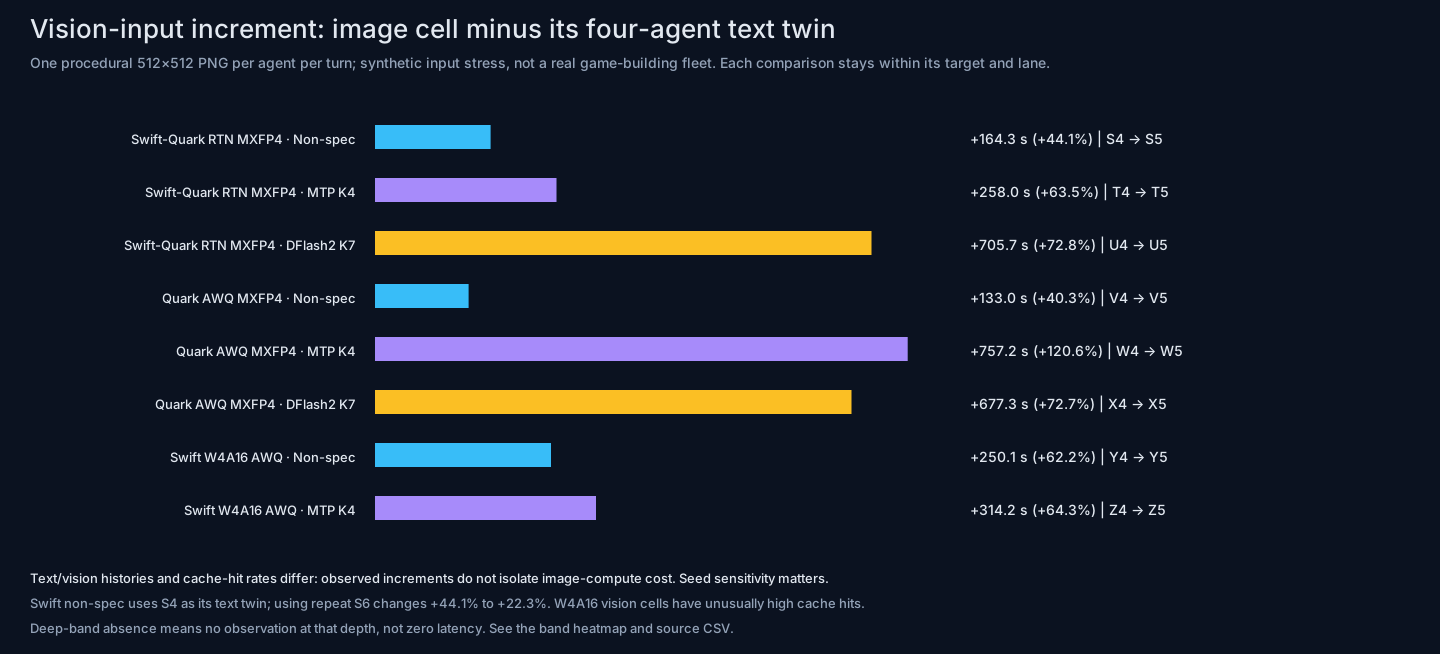
Quark’s observed increments were +133.0 s (+40.3%) non-spec, +757.2 s (+120.6%) MTP and +677.3 s (+72.7%) DFlash2 (V5−V4, W5−W4, X5−X4). Swift non-spec is +44.1% using S4, or +22.3% using repeat S6. These are history-sensitive workload increments, not isolated vision-kernel costs. Sweep source.
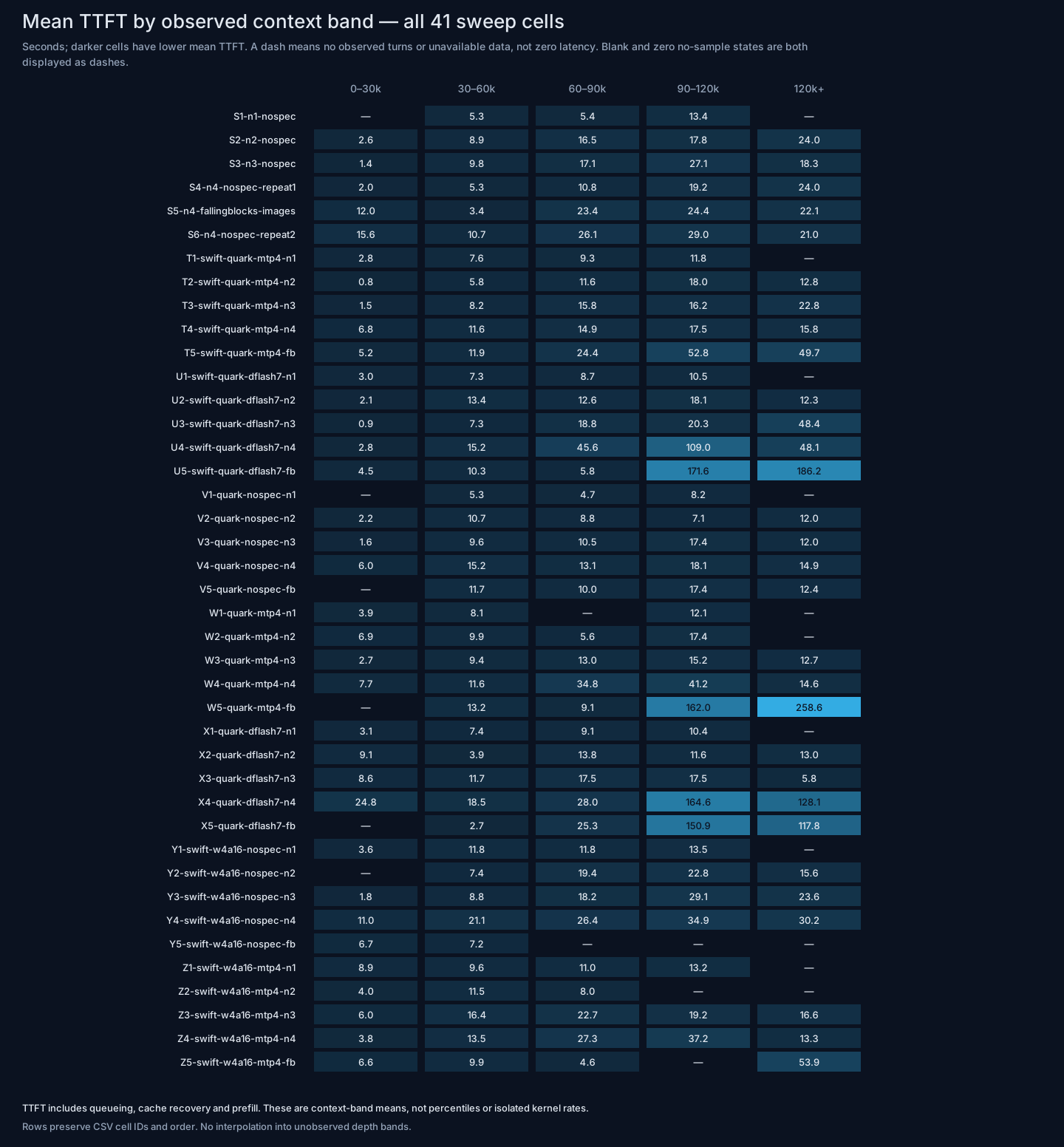
A blank or zero no-sample band is shown as a dash. No deep observations does not mean zero deep-context latency. These synthetic PNG-input cells are not new game-building fleets.
Serving outcome
The measured recommendation for four-agent service is
swift-quark-mxfp4 at 131070 / 4 / non-spec — the onboarded checkpoint on
the winning kernel path, with the style probe confirming the Swift
writing style survives the quantisation. The full sweep adds one fact:
the Quark base target on the same non-spec lane is the fastest cell at
n=4 (330.4 s) and on vision (463.4 s) — this is an observed setup difference, with boot-pool variation and limited replication. The
onboarded checkpoint stays Swift-Quark for output-style reasons; the
systemd unit and the INT4 service definition were not modified; swapping
the live service is an operator decision, and rollback remained one
command throughout.
Limits
Source files and SHA-256 hashes for all six generated charts are in the chart provenance manifest.
One run per cell (the n=4 serving point has two repeats; the campaign
E1 arm has one): the 15% repeat spread is the resolution floor, so
same-lane gaps below ~15% are not separable. Depth is capped at 126k by
the harness. turn_tg_avg in the CSV is a per-turn mean that includes
accepted-draft bursts and is not comparable to decode_tokens_s. BF16
KV throughout (FP8 KV is a separate calibration axis, not tested here).
Falling Blocks cells are seed-sensitive (see the W4A16 anomaly above)
and are used for lane ranking, not absolute numbers. KV pool size varies
by boot (2.61–4.30×) and is the master variable for same-lane wall
swing. Arm C (FP8-dynamic) and arm D (NVFP4→MXFP4 conversion) were
excluded as gate-fails; reasons in Excluded exploratory tests.
Home · Compare · vllm-radiance · radiance · Charts · Stuff for nerds · Disclosure