From 131k to 200k: what the bigger memory pool proves
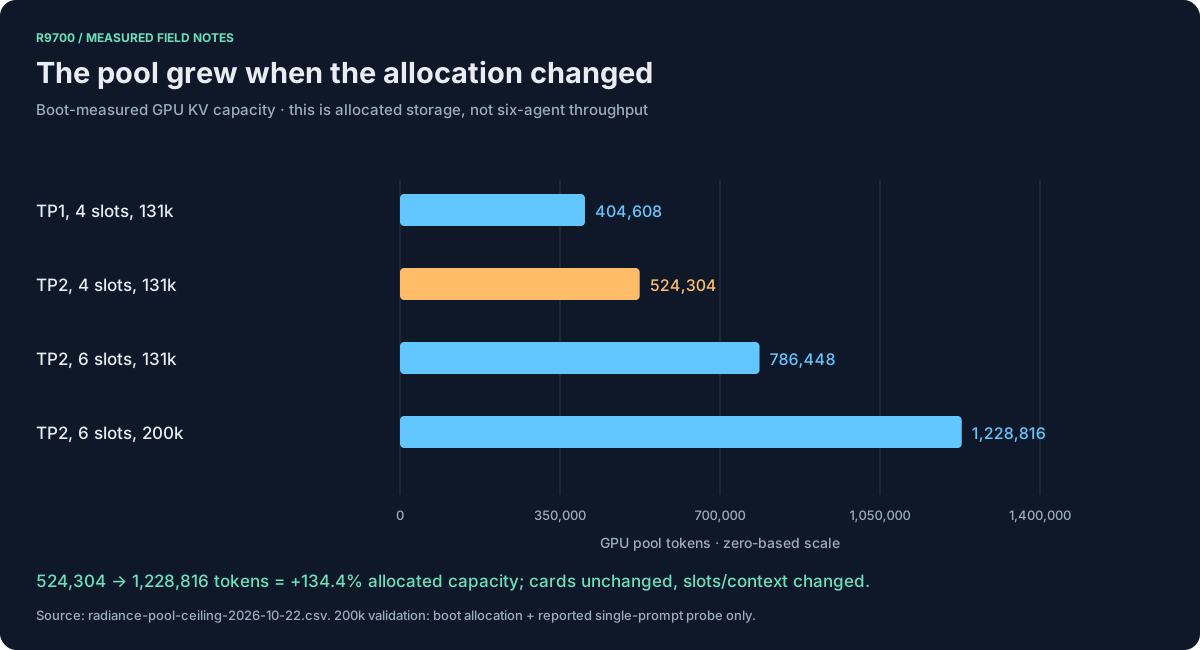
The original radiance TP2 campaign allocated about 524k GPU KV tokens. A later boot allocated 1,228,816 on the same cards: 134.4% more. The key change was the allocation target—more slots and a longer configured context—not more hardware.
That result answers a capacity question. It does not yet answer how quickly six agents can work at 200k each.
Four measured boots
The pool-ladder CSV contains these recorded boot allocations. Context uses exact token counts; “131k” and “200k” are shorthand.
| Configuration | KV GiB per card | GPU pool tokens | Full-depth allocation equivalents | Approx. KiB per token per card |
|---|---|---|---|---|
| TP1, 4 slots, 131,072 context | 14.27 | 404,608 | 3.1 | 36.98 |
| TP2, 4 slots, 131,072 context | 9.74 | 524,304 | 4.0 | 19.48 |
| TP2, 6 slots, 131,072 context | 13.61 | 786,448 | 6.0 | 18.15 |
| TP2, 6 slots, 204,800 context | 20.79 | 1,228,816 | 6.0 | 17.74 |
Per-card density = GiB on one card × 1,048,576 KiB/GiB ÷ shared pool tokens. Each shared token requires a KV shard on each TP2 card; dividing the token count by two would double the reported cost incorrectly. Total two-card storage per token is twice the per-card value. Rounded GiB values and fixed per-session overhead mean this is an allocation ratio, not one universal marginal KV cost.
Why two cards initially looked like one
A useful approximation is pool = min(available KV capacity, slots × configured context), with small engine rounding overhead. Four × 131,072 targets 524,288 tokens; the recorded TP2 pool is 524,304. Its slot target binds before the available cards do.
The TP1 pool, by contrast, is 404,608, about 77.2% of that four-slot target. It is VRAM-limited in this profile. Those two numbers were sized by different constraints.
Increasing TP2 to six slots allocates 786,448 tokens at 131k; increasing context to 204,800 produces 1,228,816. Six × 204,800 is 1,228,800; the boot allocation is 16 tokens above that target. None of these divisions is a throughput prediction.
Model context, deployment context, observed depth
The recorded conversion/model inspection reports 262,144 for n_ctx_train / max_position_embeddings. The earlier radiance deployment used 131,072; the later one used 204,800. Model metadata describes an intended context range, not a quality guarantee at every depth. The model inventory separates the conversion source and serving alias.
The operator recorded a 165,075-token needle prompt with the expected answer and repeated TTFT of 0.3–0.4 s, plus a clean rejection of an over-cap request. These are reported acceptance probes from the prior campaign record. Their raw timing and response receipts are not included in the public pool CSV, so they remain separate from the exported allocation measurements. Fast repeats alone do not isolate whether reuse came from GPU or host caching.
There is no 165–200k depth/concurrency performance grid in this release, and no six-agent 200k workload qualification. The measured TP1/TP2 campaign depths and counts remain in the single-card and dual-card reports.
The projections stay projections
| Quantity | Token estimate | Status / interpretation |
|---|---|---|
| TP2 elastic ceiling | ~1,284,500 | Projection from 22.23 GiB/card and selected allocation density; not a boot result |
| Host prefix tier, 13 GiB | 400,912 | Recorded tier print; completed-conversation state, not live GPU KV |
| Driver-cap host tier, 15.29 GiB | ~471,400 | Projection before vision/other pinned reservations; not an available usable prefix budget |
Source: the same capacity CSV, with its kind column retained. The GPU and host tiers hold different forms of state. Adding their tokens does not establish extra live-agent concurrency.
For scale, four 262,144-token allocations require 1,048,576 tokens, within the later measured GPU pool by arithmetic. That does not demonstrate four 256k requests running successfully. Five equal shares of the elastic projection would be about 256,900 tokens each; both the ceiling and that division remain unvalidated.
The capacity improvement is useful without upgrading it into a performance claim: a larger allocation target fit. The next unanswered question is its latency under simultaneous long-context work.
Home · Compare · vllm-radiance · radiance · Charts · Stuff for nerds · Disclosure