One card, four agents: the radiance single-card campaign (22 October 2026)
What ran
One R9700 card, four agents, deep-context workload. stilldeadcode/radiance 1.9.0, digest-pinned. Model: ukisai/Swift-1.5-Qwen3.8-27b-W4A16-AWQ, revision 81a28ee7 (the W4A16-AWQ conversion record names the source INT4 .rad bundle; the historical Y/Z reference uses revision 9dba8a05). Knobs: TP=1, 131,072-token context, fp8 KV, 4 sequence slots, MTP-4 speculative lane, 13 GiB host tier. Boot: weights 14.41 GiB, KV cache 14.27 GiB, pool 404,608 tokens (boot allocation, not simultaneous full-depth performance).
Growth stopping targets are min(126,000, pool ÷ agents − 12,239), with integer rounding: 126,000 / 126,000 / 122,630 / 88,913 at n=1/2/3/4. The cap is a pre-turn stopping target; max_depth_tokens can exceed it after a final growth step. Grid: 4/4 cells, 92 total timed turns, zero errors.
Source: radiance-single-card-2026-10-22.csv; the historical config JSON describes vllm-radiance, not this radiance boot.
Read the differences first
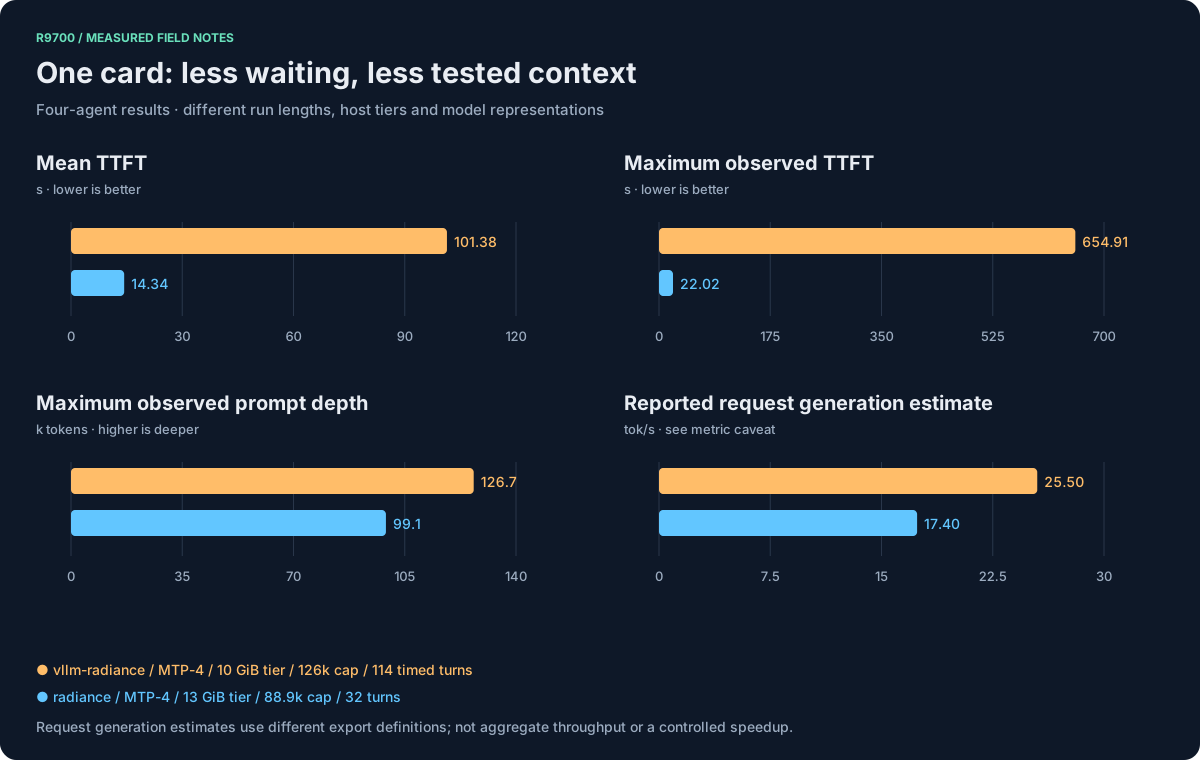
The historical GPU A reference used Swift-1.5 INT4, FP8 KV, MTP-4 and a 10 GiB host tier. Radiance uses a converted .rad representation at the recorded revision, MTP-4 and 13 GiB. Its n4 stopping target is 29.4% smaller, and the older family has longer histories and more turns. Radiance TP2 uses a 10 GiB tier and retains the 126k target at four agents. The numbers below describe these operating points; they do not isolate an engine improvement at equal depth.
| Agents | Radiance TP1 stopping target | Radiance observed max | Historical GPU A observed max |
|---|---|---|---|
| 1 | 126,000 | 120,325 | 123,462 |
| 2 | 126,000 | 123,515 | 127,278 |
| 3 | 122,630 | 123,710 | 127,658 |
| 4 | 88,913 | 99,075 | 126,691 |
Sources: TP1 grid, R1x n1–4; original GPU A follow-up, gpu-a n1–4. The historical stopping target is 126,000; neither target is a hard per-turn prompt limit.
Per-turn price and total turns
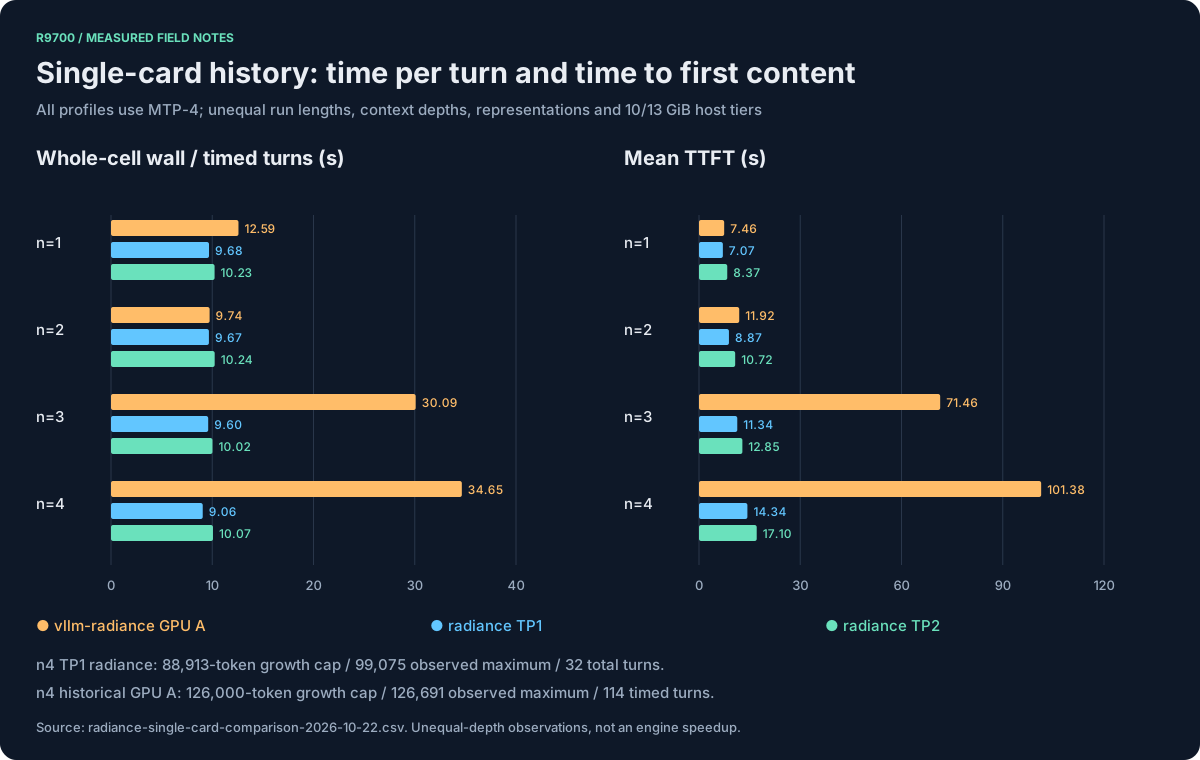
Whole-cell wall divided by timed turns, by agent count. Under concurrency this is not the mean time an individual request spends waiting and generating. Turn counts in parentheses are total timed turns across all agents in the cell, not per-agent.
| n | radiance TP1 (turns) | vllm-radiance single-card, MTP-4 (turns) | radiance TP2 (turns) |
|---|---|---|---|
| 1 | 9.68 (10) | 12.59 (27) | 10.23 (10) |
| 2 | 9.67 (20) | 9.74 (63) | 10.24 (20) |
| 3 | 9.60 (30) | 30.09 (94) | 10.02 (30) |
| 4 | 9.06 (32) | 34.65 (114) | 10.07 (40) |
Radiance TP1 n4 has 32 total turns (8 per agent). The old engine’s per-turn cost rises from 12.59 to 34.65 s — a factor of 2.75 (34.65 / 12.59), not four.
Source: radiance-single-card-comparison-2026-10-22.csv
TTFT
| n | Old engine mean (s) | Old engine max (s) | Radiance TP1 mean (s) | Radiance TP1 max (s) |
|---|---|---|---|---|
| 1 | 7.46 | 18.78 | 7.07 | 9.54 |
| 2 | 11.92 | 40.64 | 8.87 | 12.53 |
| 3 | 71.46 | 456.19 | 11.34 | 16.38 |
| 4 | 101.38 | 654.91 | 14.34 | 22.02 |
At n4 the historical run records 12 preemptions alongside long waits; that observation alone does not isolate their contribution. Radiance has 85.9% lower mean TTFT with 21.8% lower maximum observed depth. Its 88,913-token target and 99,075-token observed maximum are different quantities.
Decode estimates
Two differently scoped metrics, presented as reported:
decode_tokens_s— aggregate end-to-end output rate: total successful output tokens ÷ whole-cell wall seconds. Includes prefill, queueing, and idle gaps. Not per-request steady-state.tg_avg_tokens_s— arithmetic mean of per-turn rates (completion tokens ÷ (request wall − TTFT)) over valid turns with decode duration > 0.5 s. Excludes short and zero-token turns.
| n | Historical mean request decode | Radiance TP1 turn TG | Radiance TP2 turn TG |
|---|---|---|---|
| 1 | 40.0 | 84.4 | 137.9 |
| 2 | 32.4 | 26.6 | 41.0 |
| 3 | 26.0 | 23.3 | 25.9 |
| 4 | 25.5 | 17.4 | 16.8 |
These are not kernel benchmarks. The historical column is mean_request_decode_tokens_s from the follow-up export, not the later sweep’s aggregate decode_tokens_s. Radiance uses tg_avg_tokens_s. They are reported request/turn estimates; the release does not establish identical sampling filters across these two workload families. Historical estimates are higher at n2–4, and the radiance estimate is higher at n1.
TP1 vs TP2
TP1 walls: 96.8 / 193.4 / 287.9 / 289.8 s. TP2 walls: 102.3 / 204.7 / 300.5 / 402.7 s. The 4–6% gaps at n=1–3 do not isolate all-reduce as the cause. TP2’s pool is 524,304 tokens versus TP1’s 404,608, which holds the n=4 cap at 126k instead of 88,913. The n4 wall gap also reflects fewer turns and a smaller history target on TP1; it cannot establish single-card superiority.
Caveats
- The old-engine baseline is the 27/63/94/114 total-turn text-growth family, MTP-4 as its configuration JSON records. The radiance rows are 10/20/30/32 total turns. s/turn normalises turn count, not lane.
- The TP1 pool is boot-measured; the grid establishes the depths and counts above, not sustained simultaneous full-context performance.
- The earlier ~15% repeat spread came from a different model and is descriptive; it is not a significance threshold.
- Single host: 2× R9700 32 GiB, 30 GiB RAM, custom kernel. No universal winner.
- Fleet
cache_hit_pctis a separate metric from the sweep’sprefix_cache_hit_frac; they share no common definition. Sweep blank or 0 TTFT bands mean no sample, not zero latency. - Private probes referenced in earlier prose are not CSV-exported and are not included here.
All three configurations, per-turn wall and TTFT · Full engine comparison.
Home · Compare · vllm-radiance · radiance · Charts · Stuff for nerds · Disclosure